


Core capabilities
Consistent across six languages · complete service set · complete secure channels · extensive Chinese documentation
Consistent API across six languages
One API behavior, fully aligned across C# / Java / Python / C / C++ / Rust. Switch languages without relearning; cross-language consistency is guarded by ongoing regression tests.
Discovery
GetEndpoints / FindServers probe a Server without a Session, returning the endpoint list / security modes / supported UserTokenType.
Sessions and automatic reconnection
The full Hello → OpenSecureChannel → CreateSession → ActivateSession handshake, KeepAlive heartbeats to hold the session, automatic reconnection after a drop + subscription Republish.
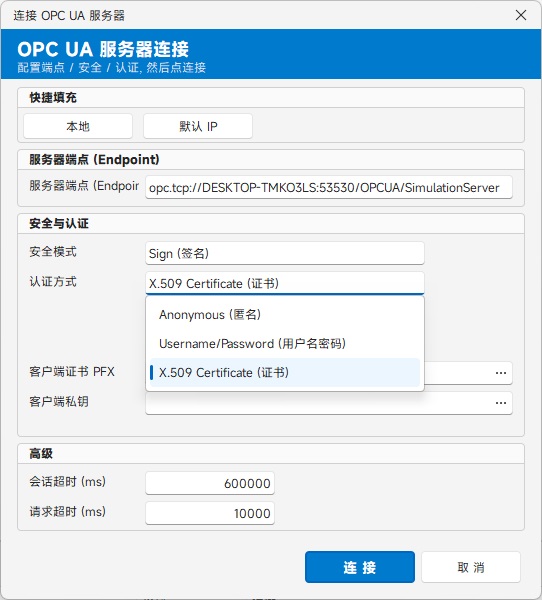
Three-level secure channels
Three SecurityMode options — None / Sign / SignAndEncrypt — with the security policy chosen automatically to match. Client PFX certificates; the server certificate is trusted on first connect (TOFU).
Four user identity types
Full support for all four UserToken types — anonymous / username and password / X.509 certificate / IssuedToken — with the secure channel decoupled from the login identity.
Strongly typed NodeId
Four NodeId object types — Numeric / String / GUID / Opaque — replacing string concatenation with one uniform representation across languages.
Variant data containers
Strongly typed Variant / DataValue containers, with value accessors such as AsDouble / AsInt32 / AsDateTime, and RAII automatic release.
Structure decoding (StructDecoder)
Decodes any ExtensionObject at run time from its DataTypeDictionary, supporting the three StructureKind values Structure / Optional / Union.
Single and batch read/write
Read / Write plus ReadMany / WriteMany: one RPC replaces N, and RegisterNodes speeds up frequent access by 30-50%.
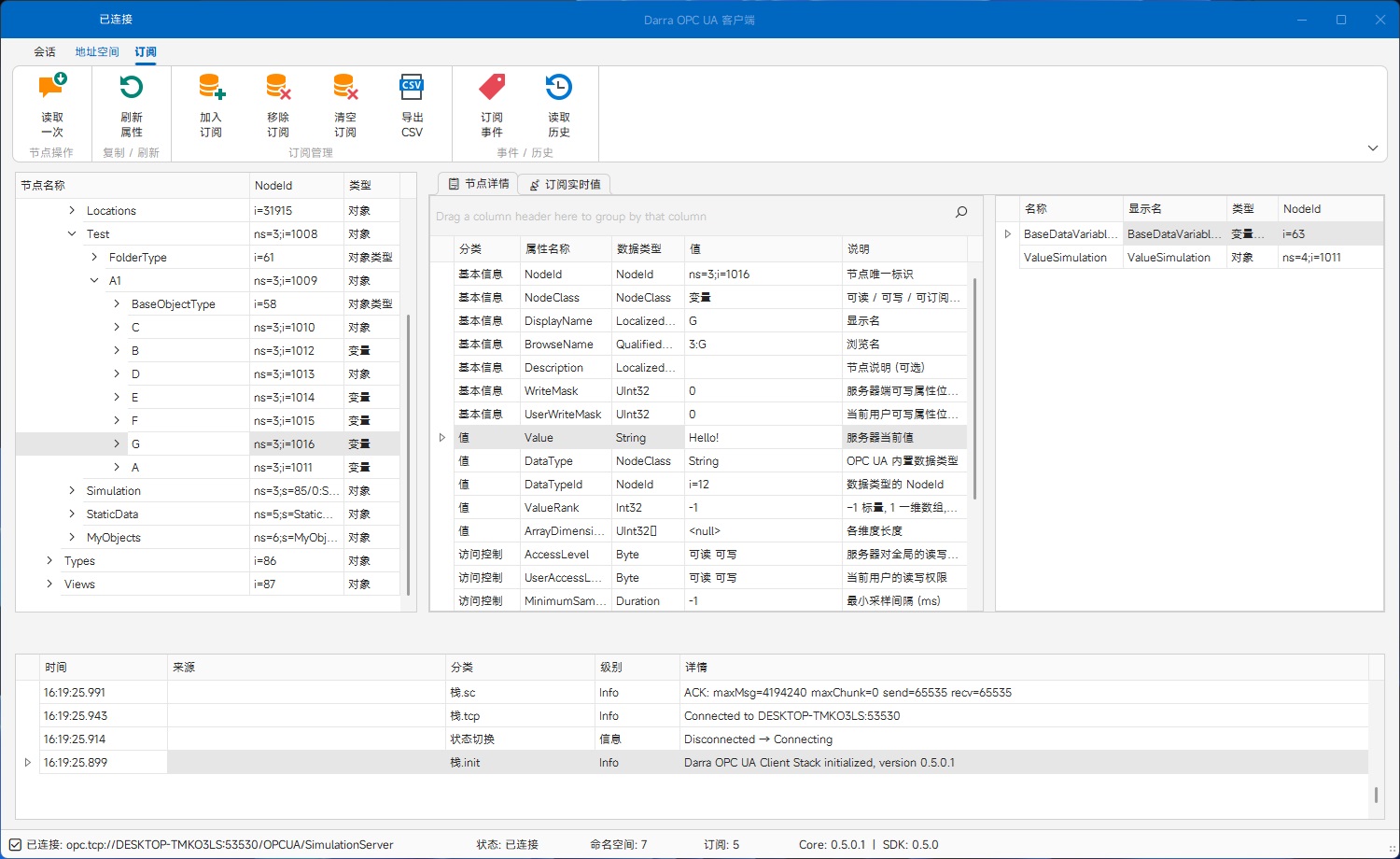
Browsing and path resolution
Complete paging with Browse / BrowseMany / BrowseWithPaging / BrowseNext, and TranslateBrowsePaths to resolve a browse path into a NodeId.
Advanced browse filtering (BrowseFiltered)
BrowseDirection (Forward / Inverse / Both) + ReferenceTypeId + IncludeSubtypes, with BrowseAll paging through the rest automatically.
Indexer-style node access
Direct indexing via ua.Nodes["i=2258"].Value, Lazy Load on demand, and remote nodes that behave just like local objects.
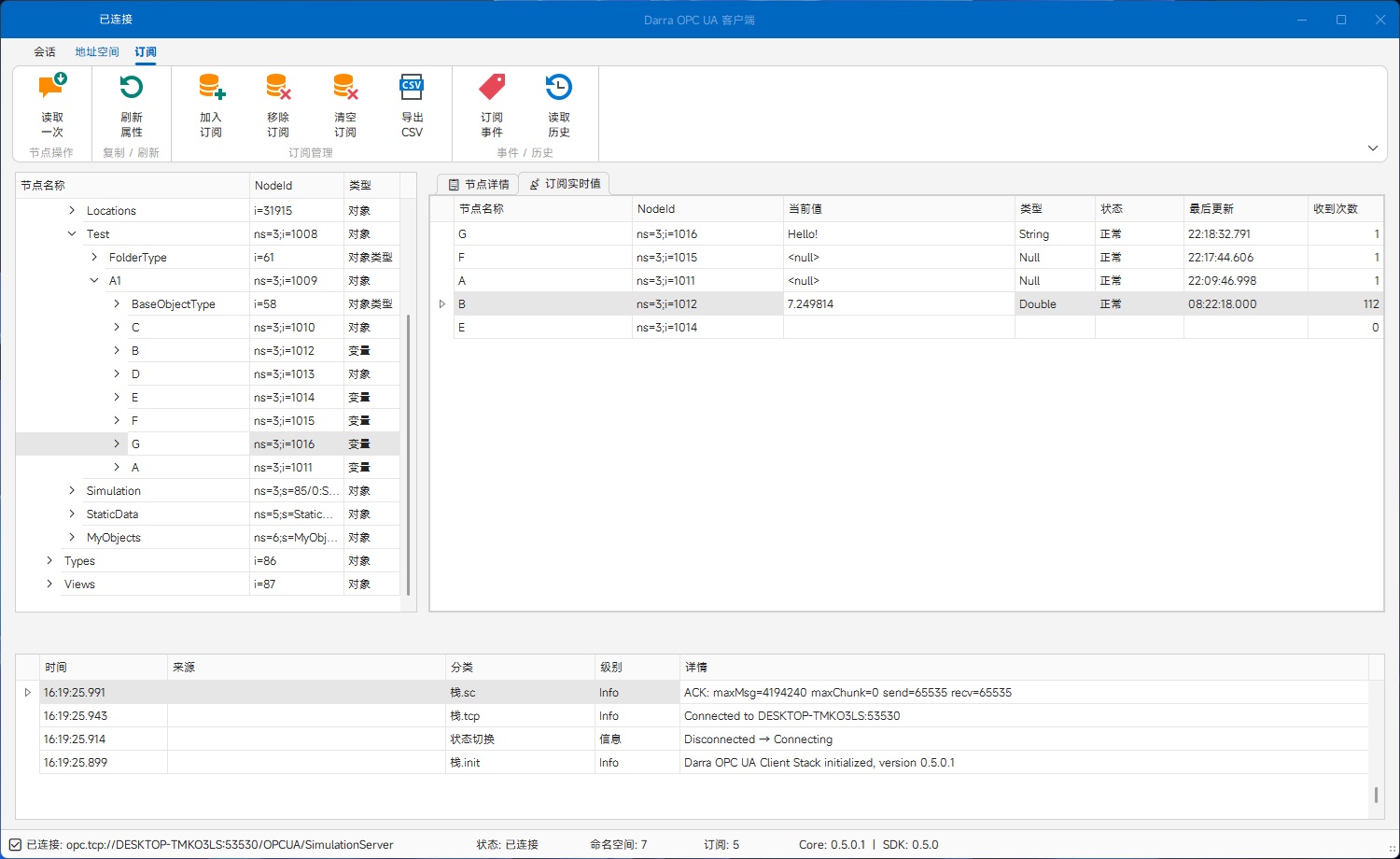
Data subscription
1000+ MonitoredItem on a single subscription, bulk add in one RPC with AddMany, separate publishing / sampling intervals, and cross-Session migration.
Data change filtering
DataChangeTrigger (Status / StatusValue / StatusValueTimestamp) + Deadband (Absolute / Percent), filtering server-side to cut redundant pushes.
Event subscription — Alarms & Conditions
Native alarm and condition event support, with the full EventFilter / Severity / SourceNode / Acknowledge / Confirm workflow.
Method Call
Calls an OPC UA Method on the server, with Variant[] inputs / outputs and full pass-through of error codes such as BadInvalidArgument / BadMethodInvalid.
Five historical access modes
Raw / modified values / a specified point in time / aggregates (Avg / Min / Max / TimeAverage) / historical events, with ContinuationPoint continuing the fetch automatically.
Historical update and delete
Insert / Replace / Update historical values, and DeleteRange / DeleteAtTime / DeleteEvents to remove a range or a point in time.
File transfer (FileTransfer)
Open / Read / Write / Close / GetPosition / SetPosition — streaming reads and writes plus resumable transfer, with FileOpenMode flag combinations.
Server information queries (ServerInfo)
One line of ReadServerStatus returns the start time / current time / state / software version / vendor, with all 8 ServerState values.
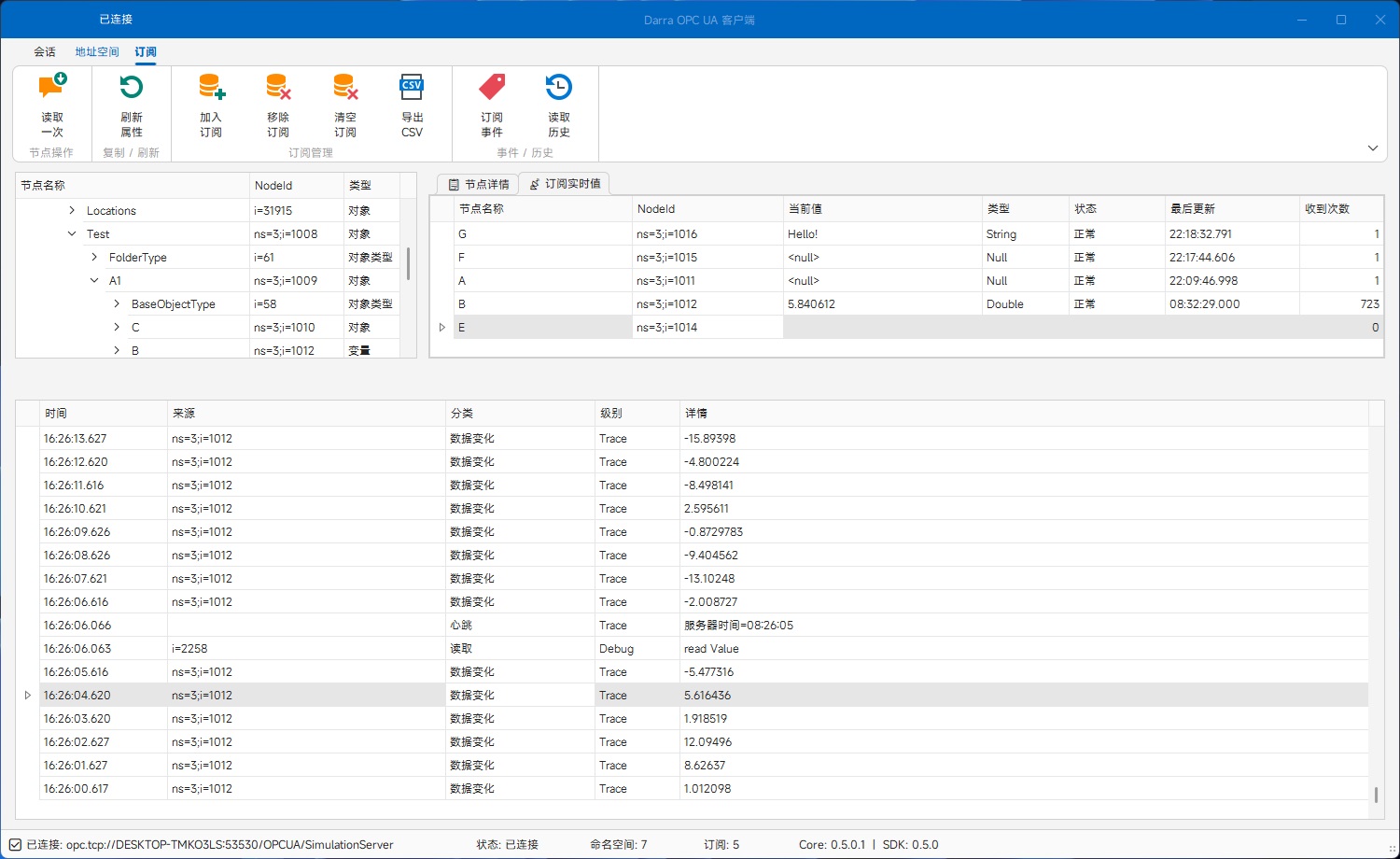
Unified event channel
ua.Events.* gathers session lifecycle / subscription lifecycle / data changes / communication faults in one place — a single hook saves work while debugging.
Certificate tools
CertificateManager.GenerateSelfSigned creates a PFX in one line, and Inspect checks the SubjectAltName URI / validity period / algorithm.